Welcome to the Cosmic Calendar!
This is a space for astronomy that looks into the night sky as a living language of rhythms and presences. "How big, how far, how fast, how much"… is just the beginning. We give astronomical facts meaning so we can better understand life above and between us.
— Sabrina Dalla Valle, Senior Cosmic Analyst
Skywatching Highlights for June 2026
JUNE is a good month for NOCTILUCENT CLOUDS (NLCs)
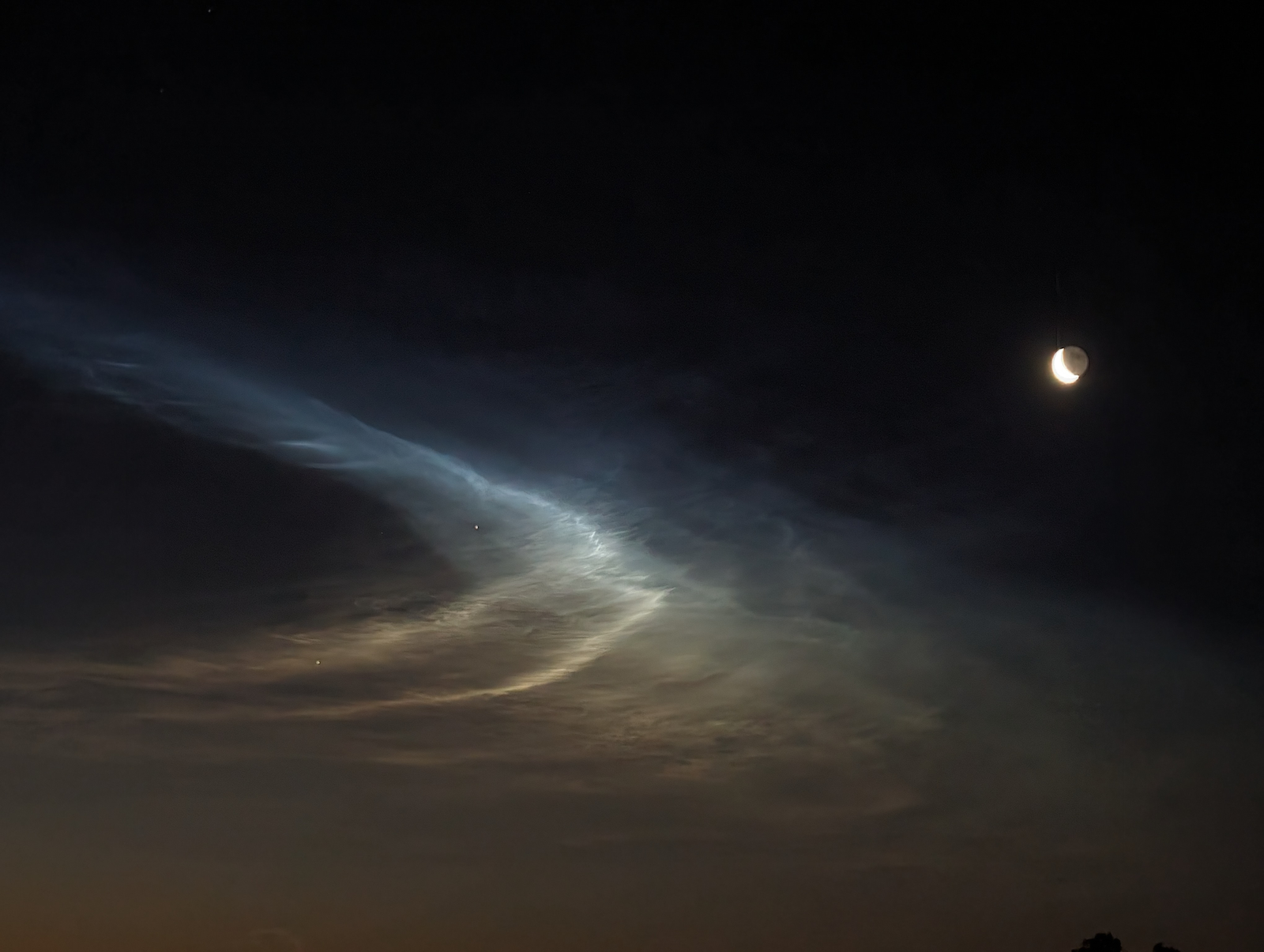
Noctilucent Cloud
TWILIGHT
If you live at higher latitudes of the Northern Hemisphere—typically between 45° and 60°—you just
might see some eerie super-natural looking nighttime clouds. They are long and thin, shaped like
tendrils or lines of waves with an electric silvery-blue shimmer. These “night-shining” or
‘noctilucent’ clouds are the highest clouds in the Earth’s atmosphere floating way out at the
edge of space, around 50 miles (80 km) above ground. They only appear in the months of
June and July when the upper atmosphere reaches sub-zero temperatures.
The noctilucent clouds are special to me because they are made in the paths of meteors, revealing their steps through space. They are formed when chilled water vapor condenses to ice around the dust left behind in their tracks... and voilà, the foundation for a glistening performance.
Noctilucents are only visible during astronomical twilight, roughly 30 minutes to 2 hours after sunset or before sunrise looking toward the north. The Earth’s curvature allows the Sun to strike higher altitudes, illuminating these clouds from below the horizon—while the lower atmosphere and ground fall into dusk’s shadow. They stand out easily because all other lower clouds are darkened by the approaching night.
You can also see artificial noctilucents if you live near a rocket launch. The first time I saw one was after I moved to Florida and watched SpaceX fly off into the distance before dawn.
If you happen to be in Florida this month, there are two scheduled launch dates.
June 8: A SpaceX Falcon 9 rocket will launch 29 Starlink broadband satellites into
low-Earth orbit. The launch window is scheduled for 6:07 a.m. to 10:07 a.m. EDT.
June 13: A SpaceX Falcon 9 rocket is scheduled to launch the Starlink 10-54 mission
at 7:11 p.m. EDT
You’ll have to check in for exact timing, hopefully they will be either early in the
morning or just after sunset.
Incidentally, the same limited viewing window also applies to observing satellites and UFOs.
Twilight reveals what the light and darkness hide.
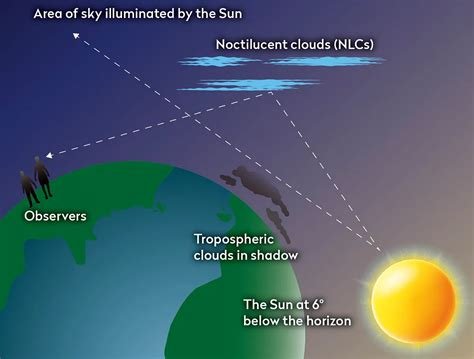
Noctilucent Diagram
OTHER SKY MOVEMENTS
8 June Third Quarter Moon. Watch this dwindling moon rise at 01:39 EST.
8—9 June Venus and Jupiter will meet like celestial ships passing in the night,
appearing 1.6° apart—which is about the width of your little finger held out at arm’s
length. These 2 brilliant planets come together in Earth’s night sky about every 3 to
5 years.
Watch them low in the western sky just after sunset. You will have about an hour to see them
before they set.
Venus (the brighter one) and Jupiter will be located near Castor and Pollux, the twin
stars of Gemini, but these stars will be tricky to see against the dusk twilight.
Jupiter is descending slowly towards the Sun and will eventually be lost from view by
mid-June before emerging as a morning planet in autumn 2026.
9—10 June EARLIEST SUNRISE OF THE YEAR happens a week or two before the solstice depending on your location based on your distance from the equator.
14 June New Moon. The Moon will be located on the same side of the Earth as the Sun in front of the constellation of Taurus and will not be visible in the night sky. This phase occurs at 22:56 EST. The nights before and after new Moon are great times to observe faint objects such as galaxies and star clusters without the interference of the moon’s glow.
Mercury at Greatest Elongation. Mercury reaches its furthest distance from the Sun, and highest point in the evening sky. You can spot it low in the west after sunset in the constellation of Gemini.
17 June The thin crescent Moon gets close to Venus just before sunset, but this will be difficult to see given the brightness of the evening twilight. By now, Jupiter will be invisible, close to the Sun below the horizon.
19 June Early risers can look to the eastern pre-dawn sky with a telescope to see a crescent Moon lining up with Saturn and Neptune in the constellation of Pisces.
21 June Solstice occurs at 04:25 EST. The North Pole of Earth will be tilted toward the Sun, which will have reached its northernmost position high in the sky and will be directly over the Tropic of Cancer at 23.44 degrees north latitude. This is the first day of summer in the Northern Hemisphere marking the longest day of the year, and the first day of winter in the Southern Hemisphere marking the shortest day.
First Quarter Moon. Summer brings the waning of the light. (Spring is really the catapulting energy of daylight. Lazy summer slides down into darkness.) From now on the night sky hours for star gazing will begin to grow longer, yay!
27 June The latest sunset for the year (depending on your latitude).
29 June Strawberry Micromoon. The first full moon of summer arrives, appearing slightly smaller and dimmer than a typical full moon because it occurs near apogee (the Moon’s farthest point from Earth). This phase occurs at 18:58 EST.
These indications are for North America EST. Remember to always check your actual location for timing and visibility. You can use this app: Stellarium.org