Welcome to the Cosmic Calendar!
This is a space for astronomy that looks into the night sky as a living language of rhythms and presences. "How big, how far, how fast, how much"… is just the beginning. We give astronomical facts meaning so we can better understand life above and between us.
— Sabrina Dalla Valle, Senior Cosmic Analyst
"Equi Nox: the Equal Night Day Cross"
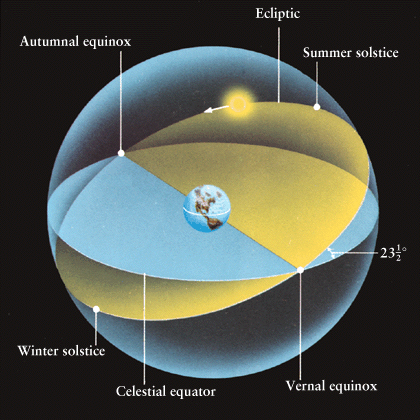
Ecliptic Equinox
THE PHENOMENON
On two days out of the year, the whole globe shares equal hours of day and night. During the March equinox, the Sun traveling on its ecliptic path will cross the celestial equator (an imaginary 360° circle in the sky projected out from the Earth’s equator) from south to north (see image). If you live in the Northern Hemisphere, it’s the vernal (spring) equinox; in the Southern Hemisphere, it’s the autumn equinox.This year, the first Equinox falls on March 20 at 14:46 UTC. We have a cultural habit in the Northern Hemisphere of saying spring begins on March 21, because it did during most of the 20th century, but actually it occurs earlier with each year during the 400-year Gregorian calendar cycle. The last time the equinox fell on March 21 using Greenwich Time was in 2007. The equinox will remain on March 20 for a long time until 2101 before returning to March 21—except for leap years when the equinox will fall on March 19. Look at the gymnastics we must do to accommodate for the fact that we cannot squeeze the relational movements between the Sun, Moon and Earth into a clock. We surely are not mechanistic but living organisms of constant variance.
THE MOVING IMAGINATION
This day is geometrically fascinating, for the Sun makes a perfect cross over the Earth.Horizontally…
For those of you who watch the Sun rise, you have noticed that the equinox is the only time when the Sun will rise precisely due east and set due west all over the globe. For the rest of the year, the Sun slides gradually up and down the horizon. In the Northern Hemisphere, the Sun will slowly work its way north towards summer solstice and then come back to center on the day of the autumn equinox. Then it will carry on, sliding southward till winter solstice where it then makes its way back to center for the vernal moment. If you are in the Southern Hemisphere, the opposite directionality occurs.
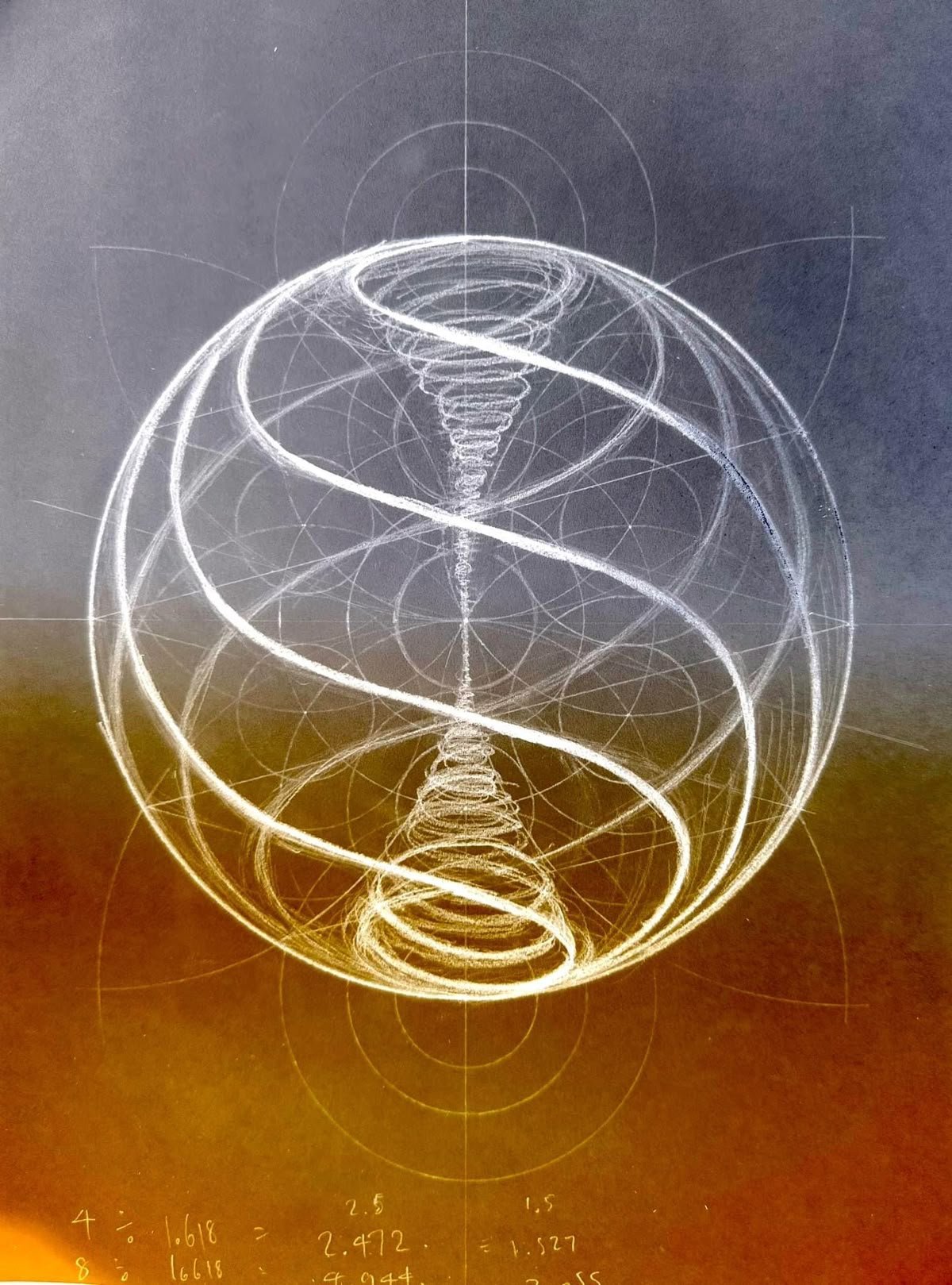
Torus Room
If you find yourself at the poles of the Earth on the equinox, you will experience the Sun’s horizontal movement all in one day, circling the entire 360° horizon line! It is a significant moment there because the Sun only sets and rises once a year—and this is the time of crossing. At the South Pole during the March equinox, the Sun will drop below the horizon, leaving it in darkness until the September equinox when it will finally rise again for its 6 months of daylight. The opposite will occur at the North Pole.
But here’s the spectacle … for one day, the Sun appears exactly the same at both poles, sliding perfectly parallel above the horizon line on both sides! This is possible due to refraction. Even though geometrically the Sun sits half below and half above the horizon, the atmosphere refracts the light that hits the observer’s eye so that the Sun appears to be about ½ a degree more above the horizon at both poles.
Vertically…
Now, at the same time during the equinox at the equator, the Sun rises and sets at its steepest possible vertical angle creating 90° with the horizon line. The Sun’s path is perpendicular to the horizon, and this verticality makes for the fastest sunset and sunrise of the year all over Earth.“The lamp of the world rises to mortals through different passages, but from that which joins four circles with three crosses it issues with better course and conjoined with a better star, and it tempers and seals the mundane wax more after its own fashion.”— Dante Alighieri, “Canto I” of Paradiso
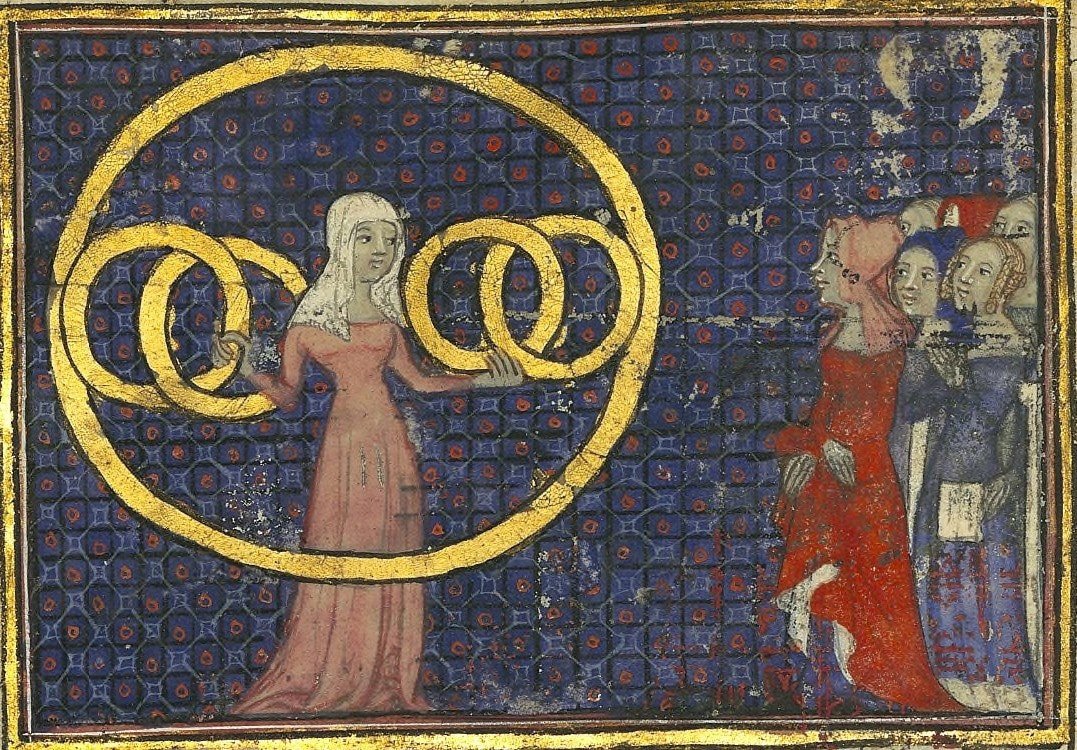
Fortunes Wheel, Guillaume De Marchaut, Paris, end of the 14th century
The great medieval Italian poet Dante is talking about how during the Northern spring equinox the sun rises from a point on the horizon where the four great circles (the horizon, the zodiac, the equator, and the equinoctial colure) meet and intersect forming three crosses. The sun is in the Tropical sign of Aries, “a better star,” because the influence of this constellation on humans below was supposed to be ‘goodhearted’ spurring on the beginning of new life (interpretation from Dianne Bean, The Project Gutenburg).
THE HUMAN EXPERIENCE
Ralph Waldo Emerson wrote, “[And we] standing as a sovereign self, align with deeper poles… We know that we traverse the whole scale of being, from the centre to the poles of nature, and have some stake in every possibility… In what is unequal there is life; in what is uniform and fixed there is the impress of death” ("Nature" in Essays: Second Series, 1844).The whole undulating drama of light and darkness passing over Earth in the course of the year passes through us as well. This mystical crossing point is not just on Earth, but within ourselves. In contemplating what brings nature forth in spring and at rest in fall between the push and pull of opposing forces of summer and winter in rhythmic alteration, we enter a practice where our soul can feel forces growing within that will strengthen it.