Welcome to the Cosmic Calendar!
This is a space for astronomy that looks into the night sky as a living language of rhythms and presences. "How big, how far, how fast, how much"… is just the beginning. We give astronomical facts meaning so we can better understand life above and between us.
Week of February 15-21: Mercury: Between Dog and Wolf
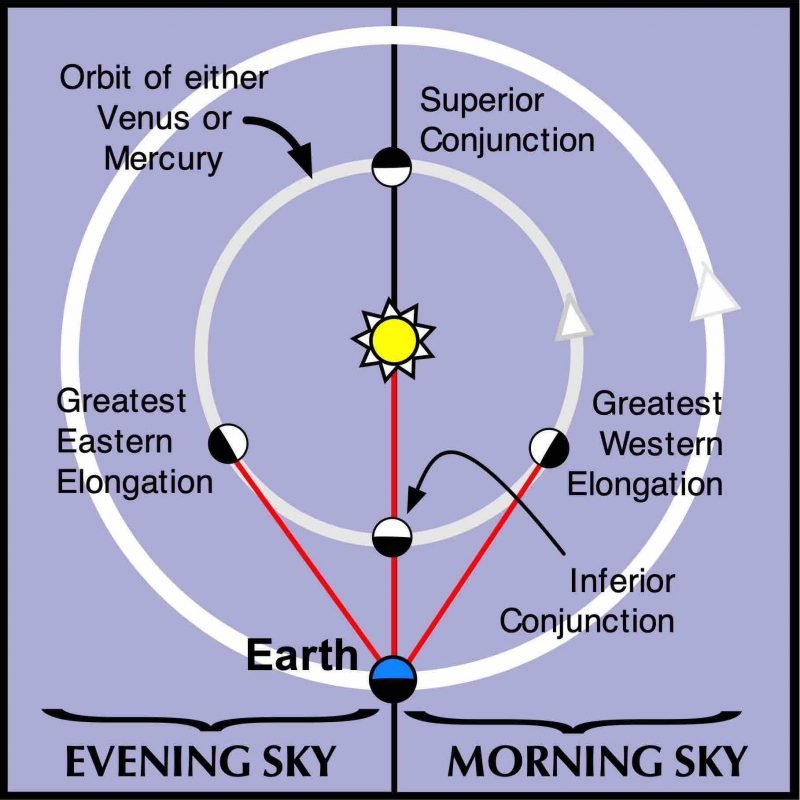
Mercury: Greatest Elongation
All the planets in the solar system are circling around the solar center, but that's not what it looks like from where we stand on Earth. We see something else, each planet with its own behavior.
Mercury is the Sun’s innermost planet, which is why it always stays near the Sun in our sky. This inferior planet is extreme, swinging between scorching highs of 800 degrees Fahrenheit during the day and frigid lows of minus 290 degrees Fahrenheit at night. And it’s swift. Because it travels at 47 kilometers per second taking 88 days to orbit the Sun, compared to Earth’s 365, it overtakes us three to four times a year, appearing to move backwards for about three weeks at a time. This is called retrograde motion—as Mercury shifts between evening and morning skies, swapping roughly every 6-7 weeks.
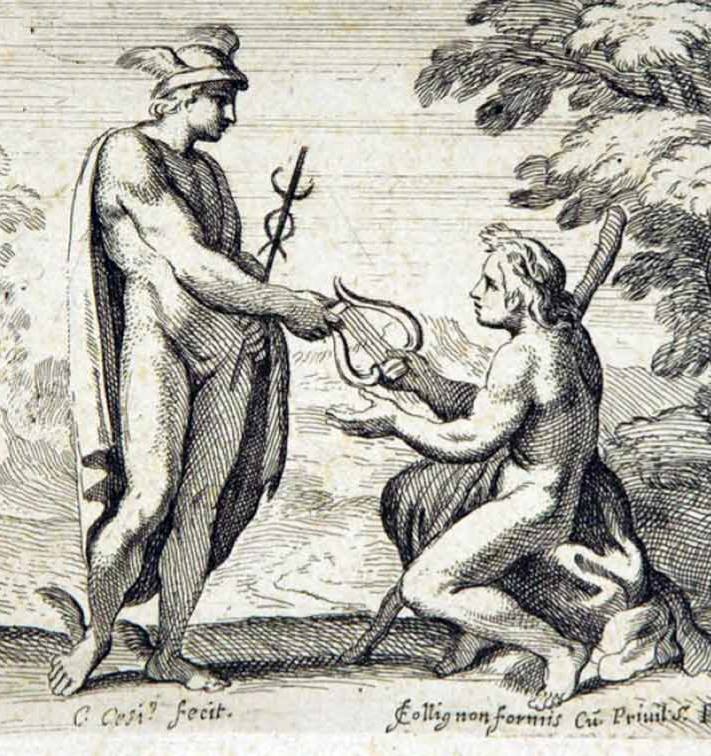
Mercury giving a lyre to Apollo
Being close to the Sun, the skies are never completely darkened when Mercury is in view. Mercury doesn’t venture too far up into the nighttime dome, nor for too long. Mercury lingers in the shadows of twilight, and depending on its rotational position around the Sun, can briefly be seen during a quicksilver moment for about an hour either ahead of the sun at daybreak before disappearing into the light, or falling close behind at nightfall descending into the underworld. In French there is a term for these in between hours, “l’heur entre le chien et le loup”, the hour between the dog and wolf. The subtle nuances in reality between known (the dog) and unknown (the wolf) are indiscernible in these twilight moments. There is trickery. Mercury, elusive.
Mercury is now in the west after sunset for the next few weeks, appearing a little higher each night. Look for it in the evening twilight rising towards Saturn. The fine waxing crescent moon will be cupping right below Mercury on the evening of FEBRUARY 18. This small, speedy planet will reach its greatest elongation, its greatest apparent distance from the Sun, in our sky shining around 0 magnitude (and still brighter than most stars) on FEBRUARY 19, 2026 . And it’ll be very close to bright Venus that night too. This will be the best evening apparition of Mercury for the Northern Hemisphere in 2026.
Mercury begins its retrograde motion on FEBRUARY 26 going invisible, attaining ‘inferior conjunction’ with the Sun on MARCH 7 before switching sides, ending its retrograde motion on MARCH 20. You can think of Mercury during this time as passing through the alchemical fires of the Sun, preparing its emergence to the east from a kind of retrograde womb. There, in the morning sky before dawn, a new life cycle begins. Mercury, reborn, reaches greatest elongation on APRIL 3, 2026 .
Mercury is tight with the Sun, so tight, that in Greek mythology, they are brothers: Apollo (Sun God) and Hermes (Mercury). In Hymn to Hermes, Homer tells us the story of how they exchange gifts to establish trust after a shaky dishonest beginning. Apollo asks Hermes to give him the lyrehe invented, and in exchange, Apollo gives Hermes a golden staff invested with transformative power. This close connection with Apollo-the-Sun-center-of-the-universe gives Hermes a unique passage to travel to the heights of Mount Olympus, home of the gods.
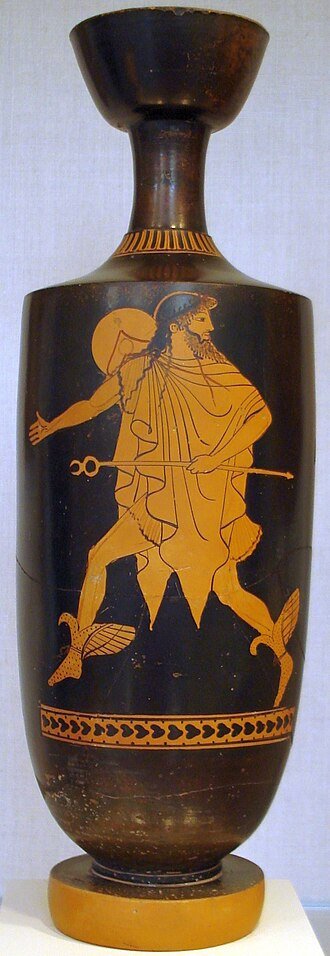
Lekythos of Hermes
But he doesn’t stop there. In The Odyssey (Book 24), Homer tells us how Hermes also lives in the underworld of Hades. Here he functions as a psychopomp, from the Greek word ‘ψυχοπομπός’ meaning "guide of souls", leading the souls of the dead with his golden staff to this final unknown place of the afterlife. Hermes is the only god who can return from Hades back to the world of the living and rise to the highest elevations on Mt Olympus.
Like his planetary form Mercury, Hermes has mastered the twilight boundary, making him a trickster who morphs things between the visible and invisible—entre le chien et le loup. Because he navigates ambiguity so skillfully, Hermes can guide us through liminal places by keeping our souls in motion. He helps us find our way when we awaken from distant dreams or even lose ourselves in mid-conversation, grasping for a vanished train of thought.
For words are tricky too, like twilight—inherently unstable, laden with multiple meanings and interpretive traps. But thinking itself is like mercurial movement: darting, shifting, crossing boundaries. Hermes drives this motion, keeping our thoughts and words spinning with interpretive possibility giving us mental agility to perceive and seize fleeting opportunities before they vanish.
This is one way we may speak to the stars.
— Sabrina Dalla Valle, Senior Cosmic Analyst