Welcome to the Cosmic Calendar!
This is a space for astronomy that looks into the night sky as a living language of rhythms and presences. "How big, how far, how fast, how much"… is just the beginning. We give astronomical facts meaning so we can better understand life above and between us.
Week of February 02-08: Big Moon kisses Regulus
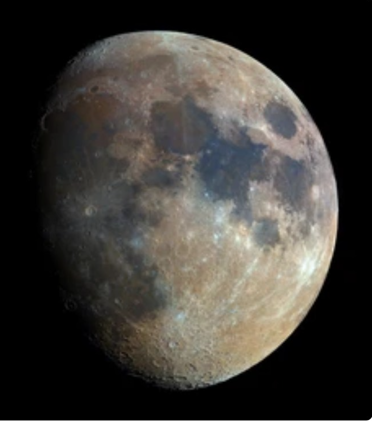
Peak Immensity: The Moon in Cancer
Well we start February off with this beautiful full moon rising in Cancer... I drove with my 90-year-old friend tonight to the water's edge at the Albert Whitted Airport in St. Petersburg to see this massive powder pink ball rise out of the water at 6:08 p.m.—exactly an hour after it reached its peak under the horizon. We melted under its immensity... It ascended quickly, gradually appearing smaller and more golden.
The moonlight will dominate our sky for the next few nights until end of week when we finally have a good 5 hours of sky watching time until the quarter moon rises at midnight. But this is a good time to prepare for what’s coming.
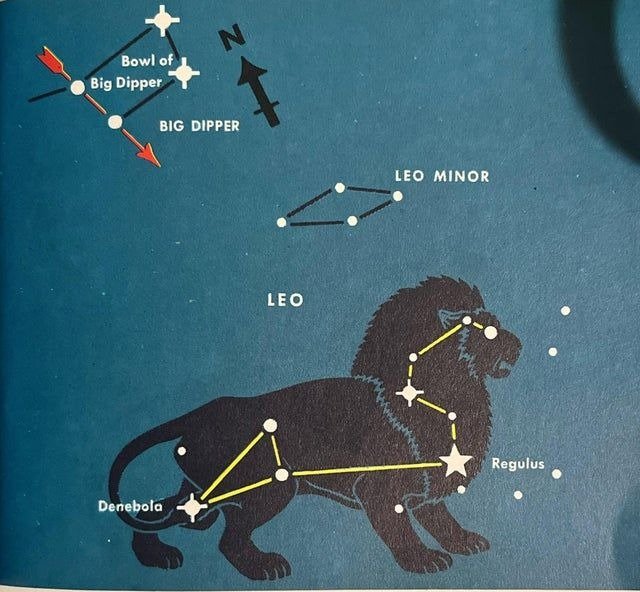
Occultation: Moon and Regulus Alignment
The moon appears full to us because it is exactly opposite the sun shining full onto its face with Earth in the middle. You’d think we’d block the sun’s light from hitting the moon, but we don’t because the moon’s orbit is tilted about 5 degrees relative to the Earth’s orbital plane, and this is what keeps the moon outside our shadow path. As the full moon rises in Cancer, the sun is setting on the opposite side of the Zodiac in Capricorn.
In astrology we think of each month as being ruled by the daylight sign—the sign where the sun is located. As astronomers we spend our time looking at the nighttime side of the Earth so the zodiacal constellation ruling the sky from dusk to dawn each month is always opposite the position of the sun. It takes some time after dusk for the night sky to awaken and by the time we can see the starlight for this week, the first zodiacal sign that rises over the horizon is Leo.
Leo will have high nighttime visibility all the way into spring. It’s easy to recognize; it’s a constellation made up of nine bright stars shaped like a crouching lion or a backwards question mark in between Cancer and Virgo. Regulus is the brightest object in Leo. It looks like a single star but it’s really a quadruple star system: four stars organized into two pairs.
Every 9.3 years the moon will pass over (occult) Regulus in a series of monthly passes that last about 6 months. The moon will pass in front of Regulus this Monday, February 2 between 8:40 and 10:00pm EST. You will be able to watch this same occultation again this year on April 26, 2026 and May 22-23, 2026.
We use this symbol ♌︎ for the constellation of Leo. It is the image of a crouching lion. In ancient times this was the symbol of “going out from the Earth into the periphery and eventually into the cosmos”. Occult tradition explains this outward reaching phenomenon well, linking the human heart directly to the stars of Leo. This ‘plastic heart’ of ours is like a vessel that generates intensified moral and religious sentiments which become seeds for our next life.
This is one way we may speak to the stars.
— Sabrina Dalla Valle, Senior Cosmic Analyst