Welcome to the Cosmic Calendar!
This is a space for astronomy that looks into the night sky as a living language of rhythms and presences. "How big, how far, how fast, how much"… is just the beginning. We give astronomical facts meaning so we can better understand life above and between us.
— Sabrina Dalla Valle, Senior Cosmic Analyst
Skywatching Highlights for SEPTEMBER 2026
These indications are for St Petersburg, Florida EDT.
You can check your actual location for timing and visibility with this app:
https://in-the-sky.org
Well my friends, we enter the month when summer turns into fall in the Northern Hemisphere and when winter moves into spring in the southern Hemisphere.
Here in the North the spring-summer light that filled nature is now most intensely breaking free and seeking a new home in the human being for its transformation. With every breath of air, we also take in the light and transform it within to make it our own. We digest it. And shining, with every look we direct outward, with every tone heard, we spread it as inner light into the darkness of space and time. This is a practice that esotericists in the 20th century called ‘The New Yoga’, what humankind needs for the future .
Summer to Autumn transition in the night sky
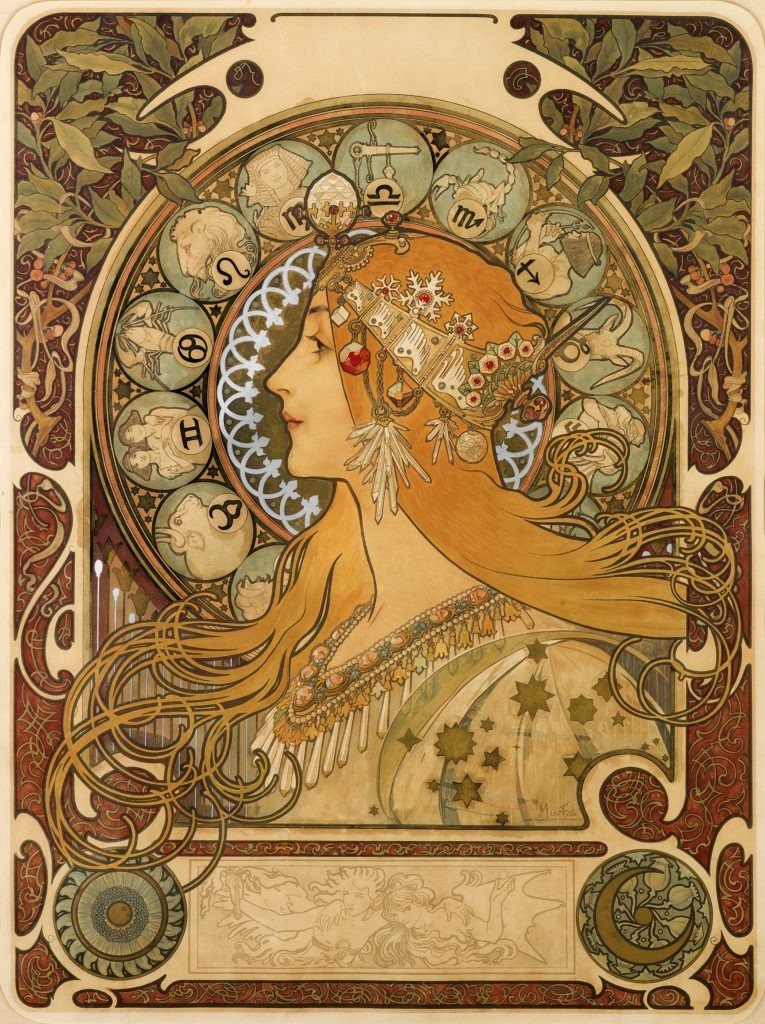
Alphonse Mucha Zodiac
Early in the month, summer constellations like Cygnus, Lyra, and Aquila (the summer triangle) remain visible in the evening before dipping lower toward the horizon.
New Arrivals
Cassiopeia, Pegasus, Aquarius, and Capricornus become prominent as autumn takes over.
Mars is located in central Gemini (right in the center of the twins) as September begins. The Red Planet rises gradually earlier around 2:45 a.m. local daylight time on the 1st, and by 2:15 a.m. on the 30th. Mars moves eastward against the background stars and crosses into Cancer on September 25. It brightens from magnitude 1.2 to 1.1 during the month, similar in brilliance to Pollux. Mars passes 6° due south of this star at midnight on the 18th.
Jupiter is in Cancer as September begins, glowing at magnitude –1.8. It rises shortly after 5 a.m. on Sept. 1, not long before twilight breaks. Jupiter crosses into Leo Sept. 24 and ends the month standing nearly 11° northwest of Regulus, Leo's brightest star. By this time Jupiter has brightened to magnitude –1.9. It's a good time for observing as it is nearly 30° high in the east around the start of twilight.
Saturn rises in early September in Pisces around 9:45 p.m., and by 7:30 p.m. on the 30th, so it will be visible all night. Saturn's rings are opening, tilted by more than 8° early in September, although they narrow slightly throughout the month.
We say goodbye to Mercury for now:
Hanging on the western horizon, but unlikely to be seen as it’s too low after sunset.
Dark-sky window best for star observations from roughly September 7 through September 14.
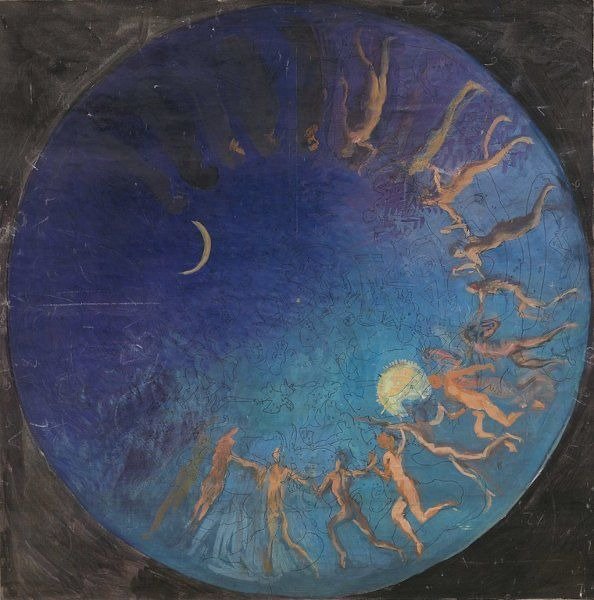
Cosmic Cycles
This is the period when the Moon disappears from the evening sky (waning from a thin crescent through New Moon on September 10 and into the early first quarter).
During this time when there's no Moon, there is, however, a faint glow from meteoritic debris that fills the inner solar system called zodiacal light. You might see it these days in the east before dawn reaching up through Leo toward where Jupiter sits. Standing at a higher altitude also helps to see this light (not so great for flatland folks).
September 2-3
Venus and Spica in Virgo are drawing closer hanging pretty low now in the west. Their conjunction falls shortly before Spica disappears into the sunset.
September 4 Last Quarter Moon
Just after midnight the half-lit Moon will be to the left of the Pleiades, forming a triangle with it and the Hyades star cluster (between the horns of Taurus near the bright orange star Aldebaran). These two naked-eye star clusters (Pleiades and Hyades) are key autumn and winter stargazing sights, so you should be noticing them a lot earlier over the coming weeks.
Uranus is in Taurus too! You will find it midway between the Pleiades and Hyades star clusters. Uranus shines at magnitude 5.7, some say potentially visible to the unaided eye from a dark location with a moonless sky. It's a perfect month to try at least.
September 6
A waning crescent Moon joins Mars some 6° away. The Moon will rise first around 2:15 am followed by Mars around 2:45 am. The Moon will also be at perigee (228,800 miles away).
September 8
The waning crescent Moon stands 5° from Jupiter in Cancer (a conjunction) on the Eastern horizon in the predawn morning.
September 9
Moon crosses at its descending node (moving south of the ecliptic).
The moon crosses the sun's path twice a month, roughly every 14 days, in a 27.2-day cycle. These crossing points mimic the alignments of an eclipse. In biodynamic gardening, these moments are known to create unstable, chaotic celestial energy that disrupts normal plant rhythms. They are times of rest and contemplation.
September 10 New Moon
New Moon occurs at 11:27pm EDT
September 13 and 14 Lunar occultation of Venus
Much of the world (but not the Americas) will be able to see a tricky waxing crescent lunar occultation of Venus. For a few hours---magic. The dark Moon surface will pass over Venus, make her disappear and reappear. But don’t feel left out, we can still see the crescent Moon near Venus just 30 min after sunset (7:36 ) until moonset at (9:34). Enjoy her for the quick hour after sunset while you can because Venus will slip away in the evening twilight next month and emerge in the morning sky in November.
September 18 First Quarter Moon
First Quarter Moon, also at apogee (251,200 miles away).
September 18-22 Venus at Peak Brightness
Venus shines brilliantly in the lower western early evening sky, reaching a dazzling magnitude of -4.8.
September 22 Equinox
This marks the official astronomical start of autumn in the Northern Hemisphere. The exact moment of the September equinox in St. Petersburg, Florida, will occur on September 22, 2026, at 8:05 PM EDT. This is when the Sun crosses the celestial equator from north to south, marking the time when night expands at its fastest rate for the year.
September 24
Moon crosses at its ascending node (moving north of the ecliptic). Do nothing.
September 26 Full Moon and Saturn
The full Moon rises in the east at the end of Pisces, with Saturn glowing just to its lower left, and Neptune between them (with a very good telescope). Best viewing time is around midnight high in the Eastern sky. This full Moon occurs just three days after the September equinox, defining it as the Harvest Moon for 2026. The rise time difference from one day to the next of the fuller Moon phases are minimized for the year around the September equinox. This means the bright Moon is present at similar times of night for a period of days, lighting the way for the farmers of old to bring in the harvest.
September 30
Say bye-bye to both Venus and Mercury just 1° and 2° above the western horizon, respectively, 30 minutes after sunset. You'll need a flat western horizon and very transparent skies to see them both. Mercury stands 9° from Venus.