Welcome to the Cosmic Calendar!
This is a space for astronomy that looks into the night sky as a living language of rhythms and presences. "How big, how far, how fast, how much"… is just the beginning. We give astronomical facts meaning so we can better understand life above and between us.
— Sabrina Dalla Valle, Senior Cosmic Analyst
Skywatching Highlights for JULY 2026
These indications are for North America EDT. You can check your actual location for timing and visibility with this app: Stellarium-web.org
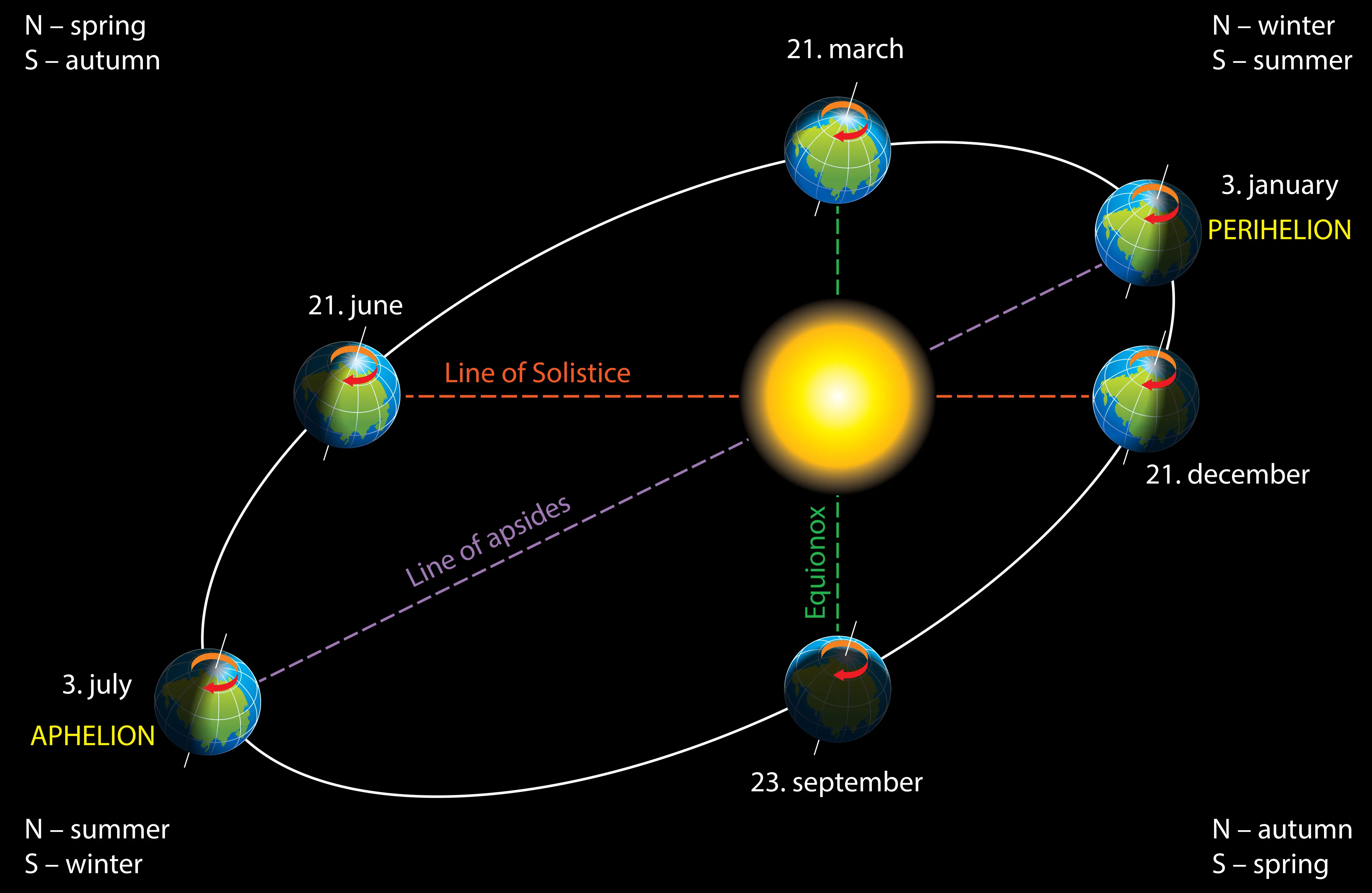
Earth Aphelion by Primal Leap
The best week for dark-sky observing is July 10–17, when the Moon disappears from the evening sky (waning from a thin crescent through new Moon on July 14 and into the early first quarter).
July is the peak month for Milky Way viewing in the northern hemisphere because the Earth is positioned in such a way that we face the Galactic Core directly. It is visible from the time the sky darkens after sunset until dawn, reaching its highest point around midnight. The core is nearly vertical from midnight to 2 AM, stretching all the way up from the southeastern horizon to the zenith.
On the Eastern horizon, find the huge rising Summer Triangle asterism made up of 3 bright stars: the brightest Vega in Lyra, and next Altair in Aquila, then Deneb in the Swan. As the season progresses, the Triangle rises higher and higher overhead. As each night progresses, you will see it rotate around the North Star (Polaris), so the apex (top of the triangle) changes. It helps remind me that everything is turning and changing its relationships. The triangle reaches the Zenith above us at midnight around the Fall Equinox.
The upper end of the Milky Way flowing through it adds another dimension of depth and context.
Jupiter — Leaving the Evening, Western Sky
Jupiter is getting fainter with each day now as it approaches the setting Sun, slipping behind it on July 7 and
disappearing until the morning of August 15 when it catches up and rises just ahead of the Sun. Then, it
will rise earlier and earlier each day and linger a little longer before the Sun comes up.
Venus — Evening, Western Sky
Venus remains brilliant in the west after sunset throughout July, though it is slowly sinking lower each evening.
By late July, Venus sets about 90 minutes after the Sun.
Saturn — Late Evening, Southeast
This month, Saturn is a planet for late night gazers rising around 1:00am at the beginning and gradually earlier
around midnight by end of month.
Mars — Morning, Eastern Sky
Mars is still a morning planet in July, rising about 2 hours before the Sun in the constellation of Taurus.
It remains small, but distinct with its orange color against the morning twilight.
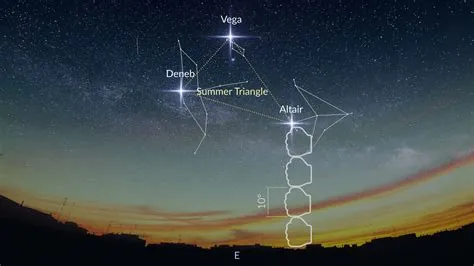
Summer Triangle by Starwalk
OK, NOW FOR A LITTLE DAILY ITINERARY
July 6: Earth at Aphelion, the farthest point in its annual orbit around the Sun. The word aphelion comes from ancient Greek, where ‘apo’ means “far”, and ‘helios’ means “Sun”.
July 9: Venus near Regulus, the dazzling evening planet Venus will pass very close to Regulus, the brightest star in Leo.
July 11: MORNING Moon, a few hours before sunrise on the Eastern horizon you’ll find the thin crescent waning Moon near Mars between Aldebaran and the Pleiades.
July 14: New Moon is hiding behind sun between Castor and Pollux next to Mercury. It’s broad daylight, but nice to imagine their meeting.
July 15: Saturn begins to be well-placed for late night observing, rising around midnight.
July 16-17: Moon is waxing crescent setting after sunset near Venus and Regulus
July 22: Venus sits roughly midway between Leo’s two bright stars Regulus and Denebola forming a wide triangle.
After midnight, the moon will descend and you will have a dark sky to see the emerging Delta Aquariid meteor shower , highest around 2 a.m. offering 15–20 meteors per hour. You can catch it again in August12-13 during the new moon happening with the Perseids.
July 29: Full Moon in the constellation Capricornus. The Sun is always directly opposing the full Moon — but this time Jupiter, which has slipped away from the night with the setting Sun, will also be opposing the Moon.