Welcome to the Cosmic Calendar!
This is a space for astronomy that looks into the night sky as a living language of rhythms and presences. "How big, how far, how fast, how much"… is just the beginning. We give astronomical facts meaning so we can better understand life above and between us.
— Sabrina Dalla Valle, Senior Cosmic Analyst
IS YOUR MIND SPINNING?
What really captures me about watching the dark sky is its pace of movement, and how awkward it feels inside myself , like I am wrestling with my sense of balance, as I adjust my orientation to find the stars circling round out there. I cannot rely on memory; I need to learn to feel the rhythm of time. My neck becomes an axis rotating to follow the dome above with the shifting hour of night or time of year to trace the stars. And I realize just to what extent I am the pivot point for my attention.
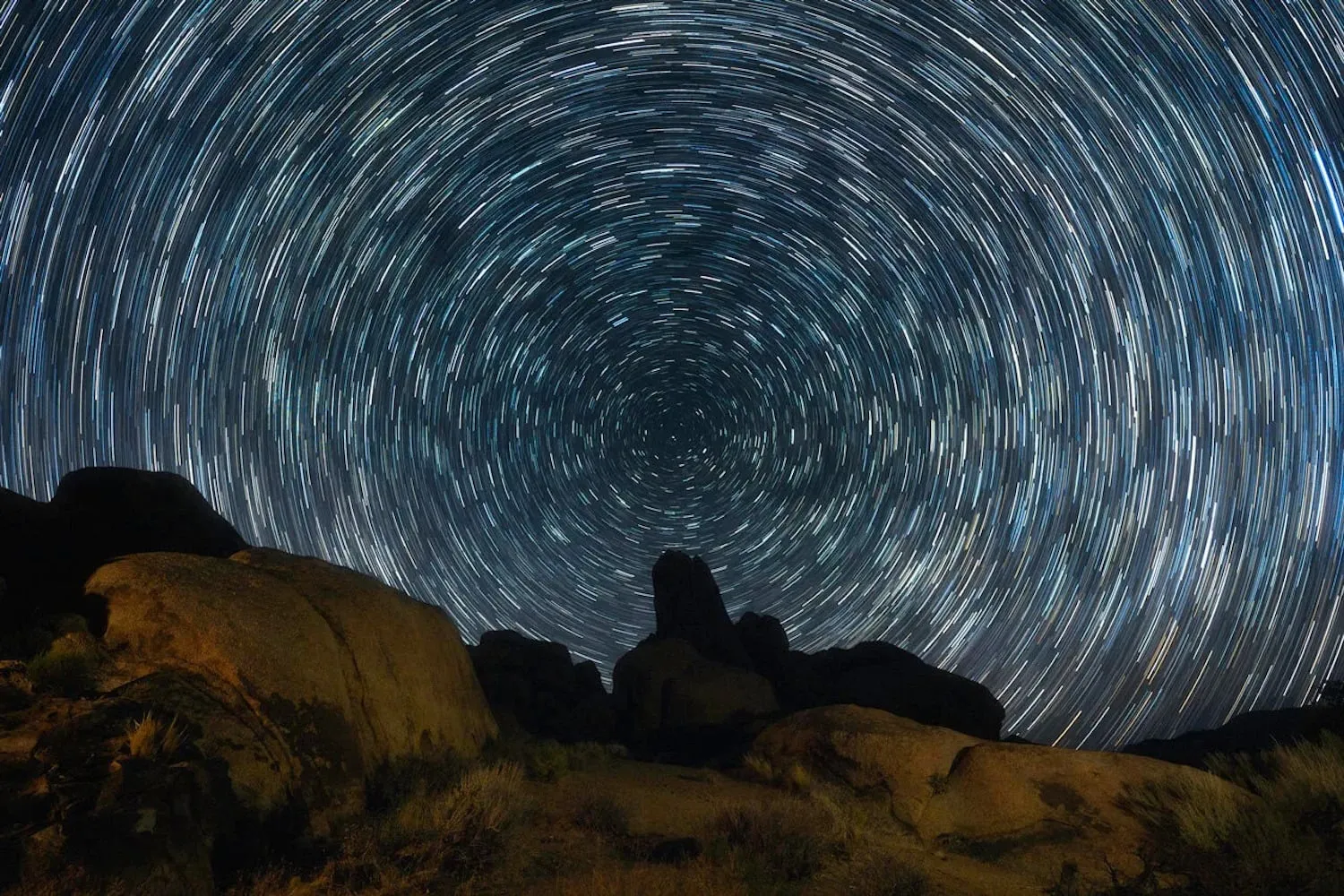
Polaris The North Star
To see, we enter a framework. The Earth rotates eastward around its tilted axis which is why it looks like the planets, sun and moon rise in the East and set in the West. If you are in the Northern Hemisphere and you face north looking towards our North Pole, the point at which the Earth’s axis of rotation meets the sky, you would see over the course of the night, how the whole set of star characters appear to rotate in a counterclockwise direction around a single fixed star. These are the circumpolar stars that never set but just move in a circle above the northern horizon. The closer you are to the North Pole, the more pronounced this motion appears.
Conversely, if you are in the Southern Hemisphere looking south towards our South Pole into the southern half of the celestial sphere, you would look right up at the Southern axial point with its polar star, and all those circumpolar stars would be turning clockwise.
The Center of the Universe Changes!
But the thing is… nothing is ever fixed, and the center of the universe from the point of view of the earth changes, and so do our stories of origin change with this recentering of the world. The Earth’s axis doesn’t point at one fixed spot forever — it wobbles slowly, like a spinning top, tracing a huge circle against the background stars that takes about 26,000 years to complete. This is called ‘precession’. Right now, in the Northern Hemisphere, the center of our circle points to Polaris in Ursa Minor, but it hasn’t always, and it won’t in the future either.
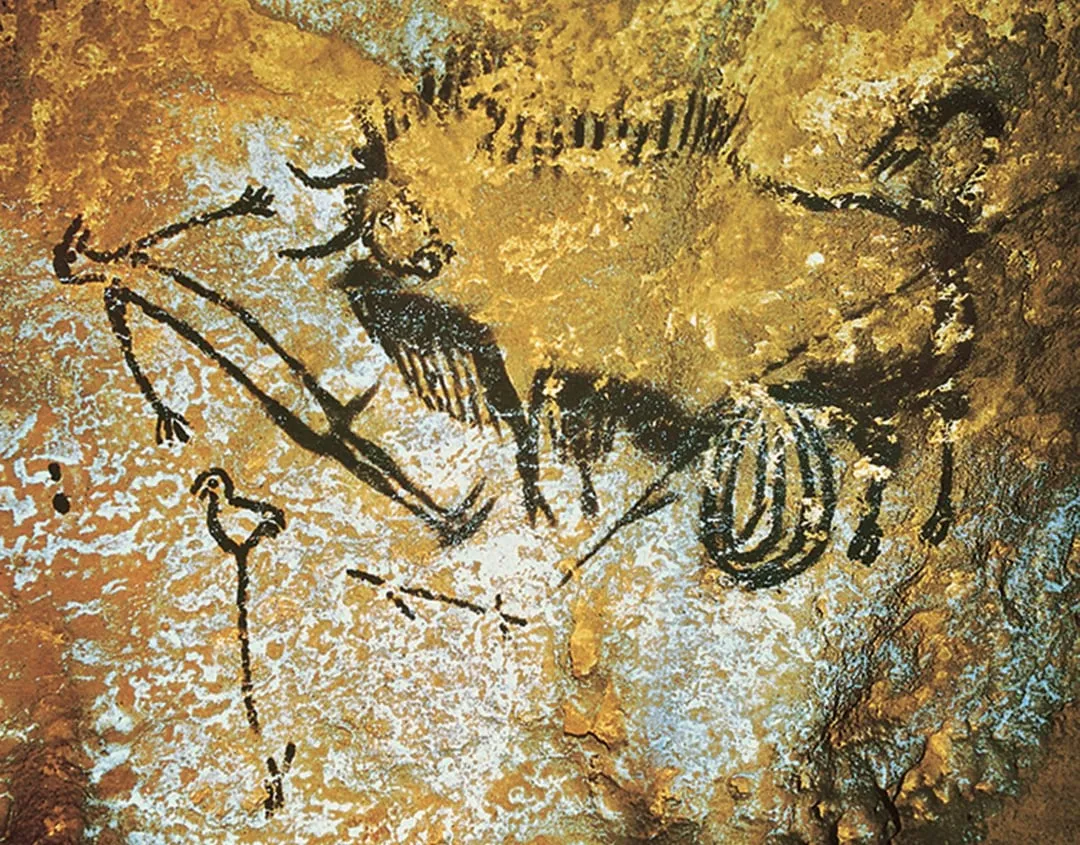
Shaft of the Dead Man in Lascaux Cave
Humans have been keeping record of this changing phenomenon for a long time. Archeologist have shown that paleolithic cave paintings are often prehistoric planetariums revealing a deep understanding of astronomy with a sky full of animals and spirit guides. The paintings in the cave of Lascaux in France dating around 16000 BC have a well-known center piece called ‘Shaft of The Dead Man’ depicting a bull, a strange bird-man and a mysterious bird on a stick. According to Dr Rappenglueck, a German archeologist, these outlines form a map of the sky representing three bright stars known today as The Summer Triangle: Vega, Deneb and Altair. It was painted when the polar star was Deneb in the constellation of Cygnus, the swan.
Fast forward to 2700 BCE, Thuban, a star located in Draco’s coiled body, became the northern pole star. Draco is a long, winding band of stars that snakes between the two Bears and coils near Polaris. To ancient Babylonian skywatchers, with Thuban at the center of the sky, this dragon-shaped constellation, which they called Tiamat, appeared as though it were wrapping around something very powerful: chaos. In their constellation story, something happens here: creation, as Tiamat is eventually defeated and split into two halves—one becoming the heavens, the other the Earth.
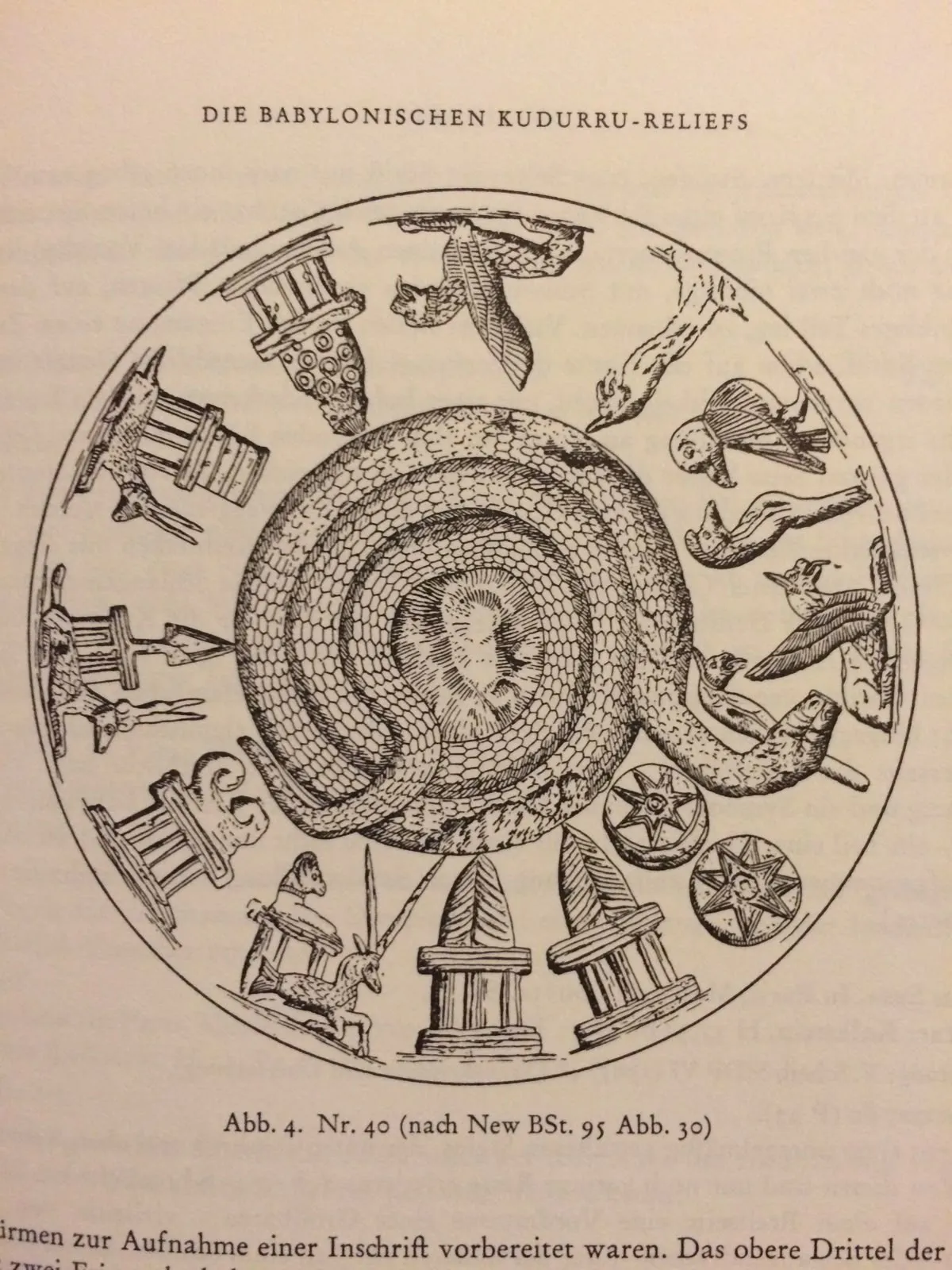
Draco
Presently, since 500 CE, Polaris has taken center stage. Some Native Americans knew it as “The Star-That-Does-Not-Walk-Around.” The Skidi band of Pawnee Indians referred to Polaris as the Chief Star providing the supreme example of how chiefs should behave. The pole star, then, was a symbol of stability, leadership and guardianship, a concept deeply ingrained in Skidi society.
Our imagination is a great organizer; it inserts itself into the sky and expands the real, determining the form which our world-concept takes. All life (which thrives on transforming change) is wrapped around this fluid, delicately moving center. And what bright star is up next to point our way, be the center of our reality?
Movement is the Mystery of Time
The next circumpolar north star rises by 3,000 CE. The slow wobble of Earth’s axis will have moved onto Gamma Cephei (γ Cep), also called Errai, the primary component in a binary star system located 44.98 light-years away. The name ‘Errai’, also known as ‘Alrai’ and ‘Er Rai’, is derived from the Arabic ar-rā‘ī, which means “the shepherd.” Who will this shepherd be for us modern people who see the celestial phenomena in the pictures formed by our mathematical, mechanical and technical faculties?
We are here confronted with certain mysteries with regard to the dynamics of time. Our movement creates our relationship with the stars, no movement-no relationship.
These are different temporal ratios, which might play, at least on the subconscious level, a role in our own psychic constitution and on the movement of our thoughts. We indeed are time signatures, but we have lost the ability to hear what the constellations are saying to us.

Solar Panel Farm
We have entered a new era—robotic and technological, and with it an entirely different sense of our origin and “life” is ahead of us. The reality of our artificial intelligence is becoming its own starlight, its own star center. On July 9, the US Federal Communications Commission approved a test program proposed by a company called ‘Reflect Orbital’, to launch a constellation of satellites designed to produce “sunlight on demand” with mirrors that beam sunlight down to Earth so solar farms that power AI can operate after sunset. The first prototype named Eärendil-1 will launch later this year. This is a 60 foot mirror, the first of a projected 50,000 that will create the first epic artificial constellation by 2035. Reflect Orbital claims that one mirror will be capable of reflecting as much light as a full Moon over a roughly nine square mile area for about five minutes at a time.
I find the name for this human created artificial constellation very pertinent. Eärendil appears in an old English poem by Cynewulf titled Christ I, “Éala Éarendel engla beorhtast”—“Hail Earendel, brightest of angels.” This story inspired J.R. Tolkien to create a mythology for England, and thus began the Middle Earth Legendarium.
As part of our dark sky disappears, in a way, we too are cut loose from our physical connection.
Can we ponder on the nature of the changing universe, on the changing frame of our reality, and maybe some day see the stars through this artificial light barrier in a different way, through new forces and interiors of connection? How have past astronomical mysteries created a foundation for this future? What did Tolkien see in Earendil? Is this the new shepherd?
Stay tuned to find out…