Welcome to the Cosmic Calendar!
This is a space for astronomy that looks into the night sky as a living language of rhythms and presences. "How big, how far, how fast, how much"… is just the beginning. We give astronomical facts meaning so we can better understand life above and between us.
— Sabrina Dalla Valle, Senior Cosmic Analyst
Slain at the Zenith
the Sun, the Self, and the Twice-Born Year
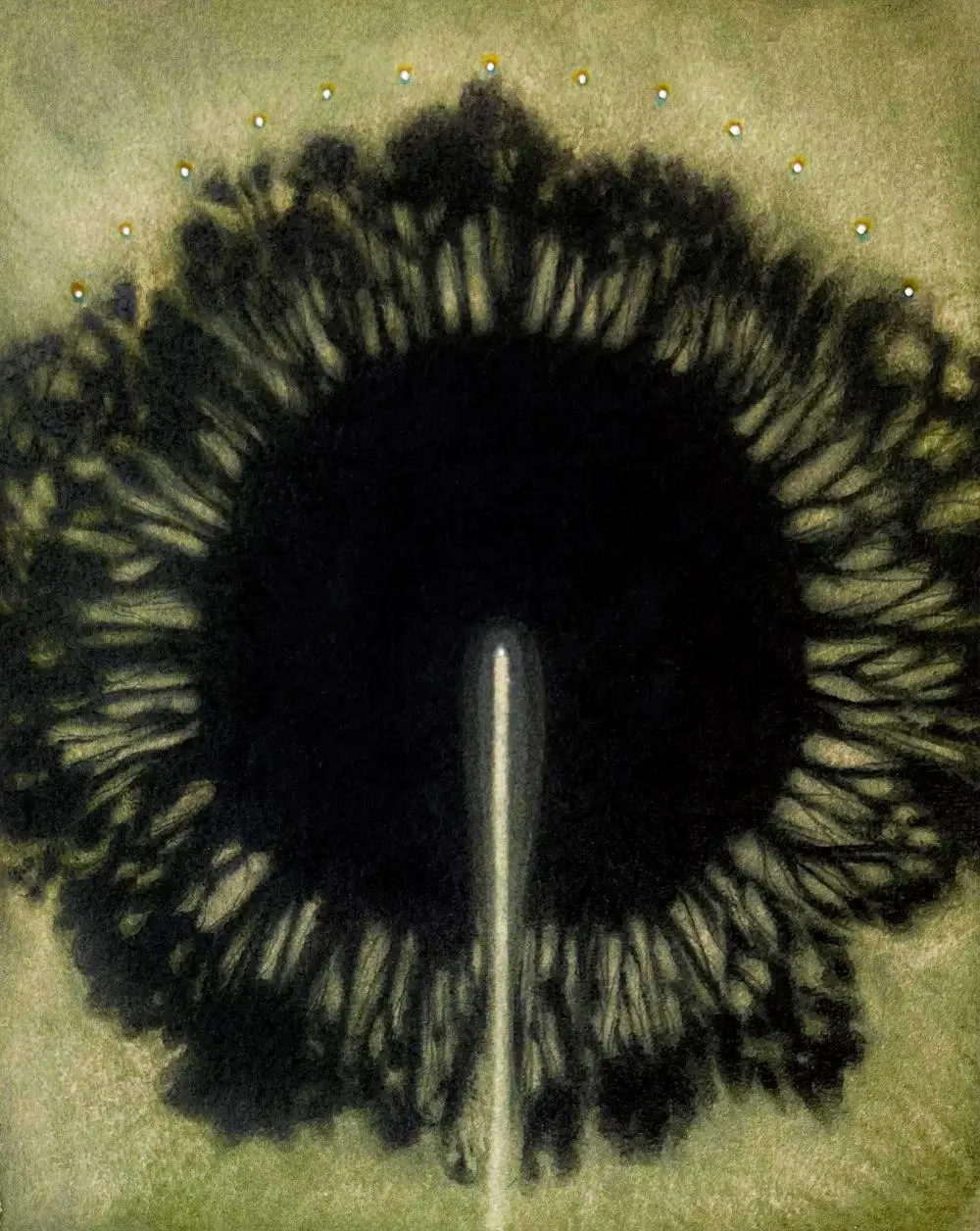
Terra Keck painting
Sometimes it's more interesting when nothing happens. On the solstices, nothing happens. But it takes a lot of preparation for this nothing to happen. In this case, it's about the nothing that happens at the beginning and end of the earth's annual, great long breath.
Just as all living things exist in a rhythm of breath, so does the earth breathe—inhaling and exhaling on a sway between its northern and southern poles, spreading out largely into the big luminous summer sky on one end and withdrawing back into a dark winter interior center on the other.
This is not just a romantic notion, it is the “great principle of undulation in nature” that Ralph Waldorf Emerson wrote about. “[It] shows itself in the gradation between inspiring and expiring of the breath, in desire and satiety, in the ebb and flow of the sea, in day and night, in heat and cold, and as yet more deeply ingrained in every atom and every fluid known to us under the name of polarity” (The American Scholar, 1837). And so, natural life is contained in this polarized undulation.
You could say the Earth generally has 365 daily breaths in a year between night and day. That breath becomes more lopsided over time as you approach the poles—until the pattern breaks at the Arctic and Antarctic Circles. As you may know, at the north and south poles, there is literally one long day and night that lasts an entire solar year, with one sunrise at the spring equinox and one sunset at the fall equinox. Here, the earth inspires and expires in one continuous, smooth annual breath.
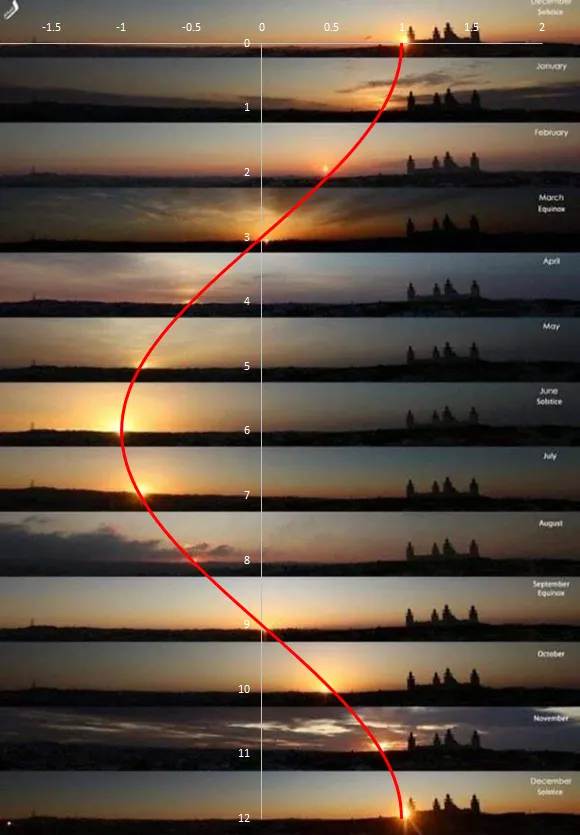
12 Month Sunrise in the same location
The Magical Silent Pause
In the Northern Hemisphere, scattered through our gradient latitudes, we are now getting close to summer's “longest-light” day. The closer you are to the Arctic Circle, the longer day you will have. This is the end of the year's full exhale into the greater cosmic day. Meanwhile, the Southern Hemisphere comes to the top of their deep inhale into their longest night drawing into itself the memories of “it's day”.
At the top and the bottom of each breath, just after the Solstice extremes of the year, is a still moment. The word solstice literally translates from Latin as “sun stands still.” For about three days around December 21st and June 21st the sun stops its southward or northward drift (its declination) along the horizon and its mounting or descending arc into the sky for a centering pause.
And where are we when the earth's relationship to the Sun goes quiet?
At the still point of the turning world. Neither flesh nor fleshless; Neither from nor towards; at the still point, there the dance is, But neither arrest nor movement. And do not call it fixity, Where past and future are gathered. Neither movement from nor towards, Neither ascent nor decline. Except for the point, the still point, There would be no dance, and there is only the dance (“Burnt Norton” in Four Quartets).
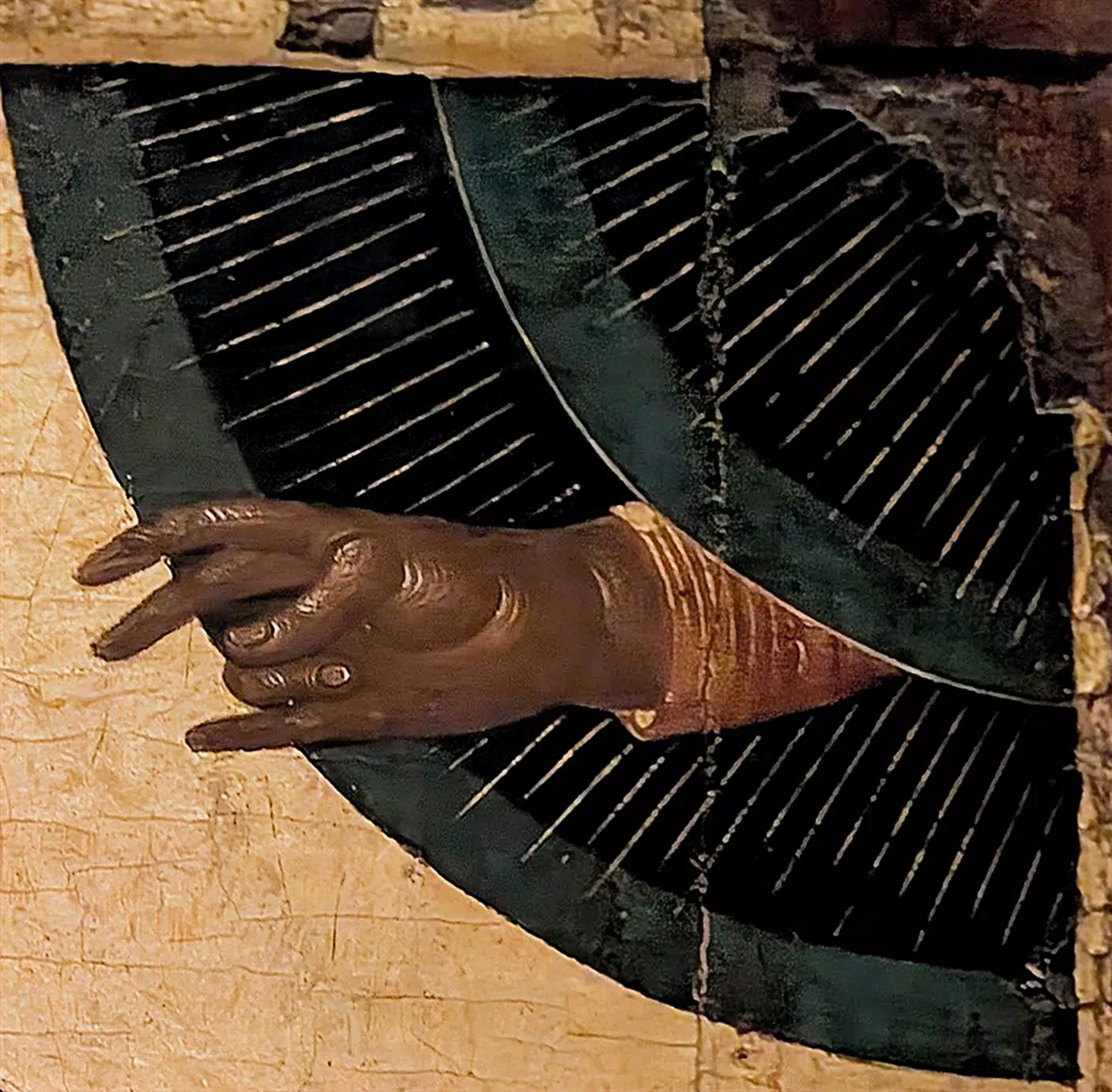
Byzantine icon
Here, the American born British poet T.S. Eliot creates a space for us, this center-point of gravity, where we get to step aside from the frantic movement of regular clock time. For a few days, the pendulum stops and time feels suspended before the direction reverses. The pause becomes a “vanishing point,” where the boundary between the individual self and the universe dissolves and the dance begins.
The Exceptional Double Beat
However … if you live at the equator, you completely bypass this polar relationship. The equator holds the center all year with a constant alternation between equal 12 day and 12 night hours. The equator is the one latitude that can hold this equilibrium because it remains perpendicular to the Earth's axis and stays geometrically constant relative to the sun's path. In a way, the equator is the world axis—an invisible diaphragm from which all action proceeds.
And there, something unique happens. The Sun's daily arc across the sky (its declination) doesn't just slowly rise to the Zenith and descend once over the course of the year. Instead, it does this twice, reaching the apex at both the March and September equinoxes. This means the sun hits its peak and valley in the sky twice as fast as it does for the rest of the planet—and with intermittent timing between the solstices, like half notes to the whole notes. The equatorial year functions like a double-heartbeat within the one breath of the solar year.
This is the mystical center—the place from which the cycle of rising and falling as a symbol of life and death is witnessed twice in a year; the Sun is twice born. Herein lies an old occult practice. In many ancient traditions, the initiate had to be born and die not once, but twice. The first round is the dissolution of the ego-self. The second is the dissolution of the spiritual self into the divine cosmic world.
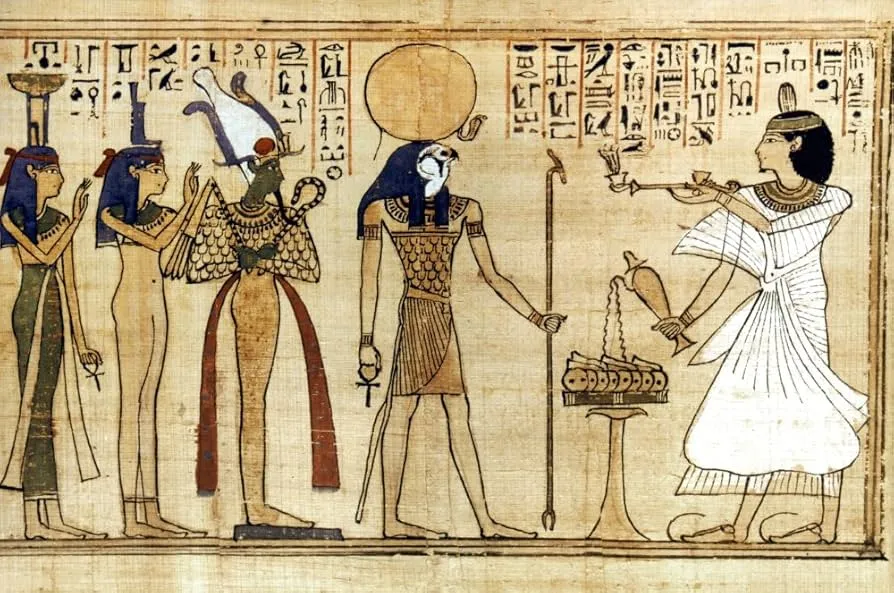
God Re Harakhte 1000BC
The Second Birth
This is the mystical center—the place from which the cycle of rising and falling as a symbol of life and death is witnessed twice in a year; the Sun is twice born. Herein lies an old occult practice. In many ancient traditions, the initiate had to be born and die not once, but twice. The first round is the dissolution of the ego-self. The second is the dissolution of the spiritual self into the divine cosmic world.
The Egyptian mysteries held the twice-born teaching as their core principle. It was the foundation of their priest initiations that performed a ritual death where they were induced in a coma and placed into a sarcophagus to meet with Osiris, the god of the dark underworld. After three days, they would be awakened to later rise with Osiris' twin, the Sun god Ra of the illumined heavenly world, and be transformed, claiming a new identity.
Death was not seen as the end, but the threshold of the real birth. Osiris provided the underworld matrix of dark winter with its power of resurrection. Ra gave the virtues of the summer Sun: active cosmic energy, light, and warmth.
The big turn at summer solstice prepares us for the great interior gestation of the Second Birth. Likewise, the winter solstice turn awakens us into that cosmic expression of the seed hiding deep within whispering “new life”.
At these two extreme astronomical points in the year, we can touch the great creative world and feel the Dance alive at the center of all centers “At the still point of the turning world.”