Welcome to the Cosmic Calendar!
This is a space for astronomy that looks into the night sky as a living language of rhythms and presences. "How big, how far, how fast, how much"… is just the beginning. We give astronomical facts meaning so we can better understand life above and between us.
— Sabrina Dalla Valle, Senior Cosmic Analyst
Skywatching Highlights for AUGUST 2026
These indications are for North America EDT.
You can check your actual location for timing and visibility with this app:
https://in-the-sky.org/
Dark-sky window from roughly August 9 through August 15.
Moon disappears from the evening sky (waning from a thin crescent through New Moon on August 12 and into the early first quarter).
We continue to have great views of the Milky Way this month.
From mid-latitude northern hemisphere locations, the bright galactic core begins the night in the southern sky and moves toward the southwest. The moving position of the Milky Way through the visibility months changes. At the equator you will find the most marked pattern from spring into late summer where the Milky Way appears first horizontally as a band along the Southern Horizon and then gradually stands upward lifting itself straight up and over into the north.
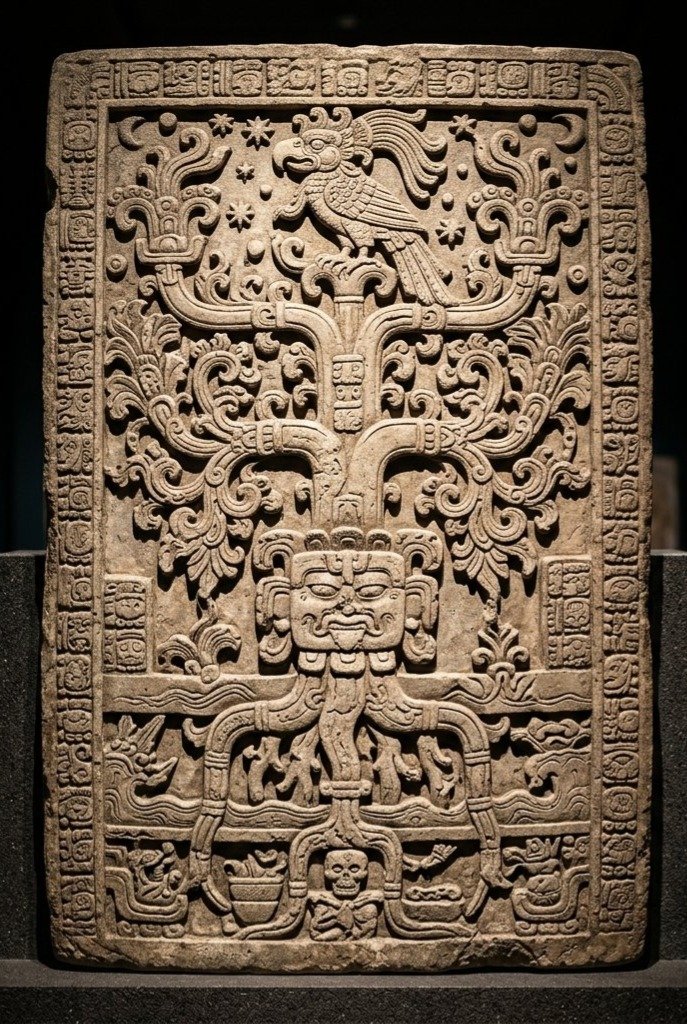
Wakah Chan The World Tree
This "erect" posture is what the Mayan astronomers (who lived just north of the equator) were describing as ‘Wakah Chan’, the World Tree. Scholars studying the Palenque inscriptions (Freidel, Schele, and Parker's work on Maya cosmology) have tied the mythological "raising of the World Tree" to a specific date — August 13 in the Maya Long Count era. This date functions as their creation moment: the World Tree/Milky Way lifted up as the cosmic axis of the universe linking the underworld, earth, and sky.
August 2 Mercury at greatest western elongation
Mercury will reach its maximum angular separation from the Sun (19°28'), making this the best time to observe the planet. Look for it in the morning, eastern sky rising about 2.5 hours before sunrise positioned in the constellation Gemini. Rising time varies with your location. Check here for a planetary calculator:
https://aa.usno.navy.mil/data/mrst
August 3 Comet 10P/Tempel reaches peak brightness
This comet was first spotted on July 4, 1873. It takes about 5.5 years to orbit the sun and thus come back into view with the help of binoculars or a telescope. It’s circling back around now through Capricornus, which you can find in the wee hours of the morning after midnight arching from the southeastern to southwestern horizon, setting before sunrise. Astronomers say this comet will be reaching its brightest illumination since 1967.
August 6 LAST QUARTER MOON
August 12 is the biggest astronomy day of the month!!!
Start your day about an hour before sunrise and find SIX PLANETS stretched across the sky. This sounds good, but it’s not really that visible. Mercury is low in the east, while Jupiter is even closer to the horizon rising about an hour before the Sun and may even be lost in haze or bright twilight. Mars will be slightly above Mercury, almost 4 hours ahead of the Sun. Then up at the Zenith you will find Saturn, with invisible Neptune a little to the east and invisible Uranus a little to the west. You will have to be a practiced telescope watcher to find them. Even though their positions will change slightly, this lineup is visible over several mornings in the dark week ahead.
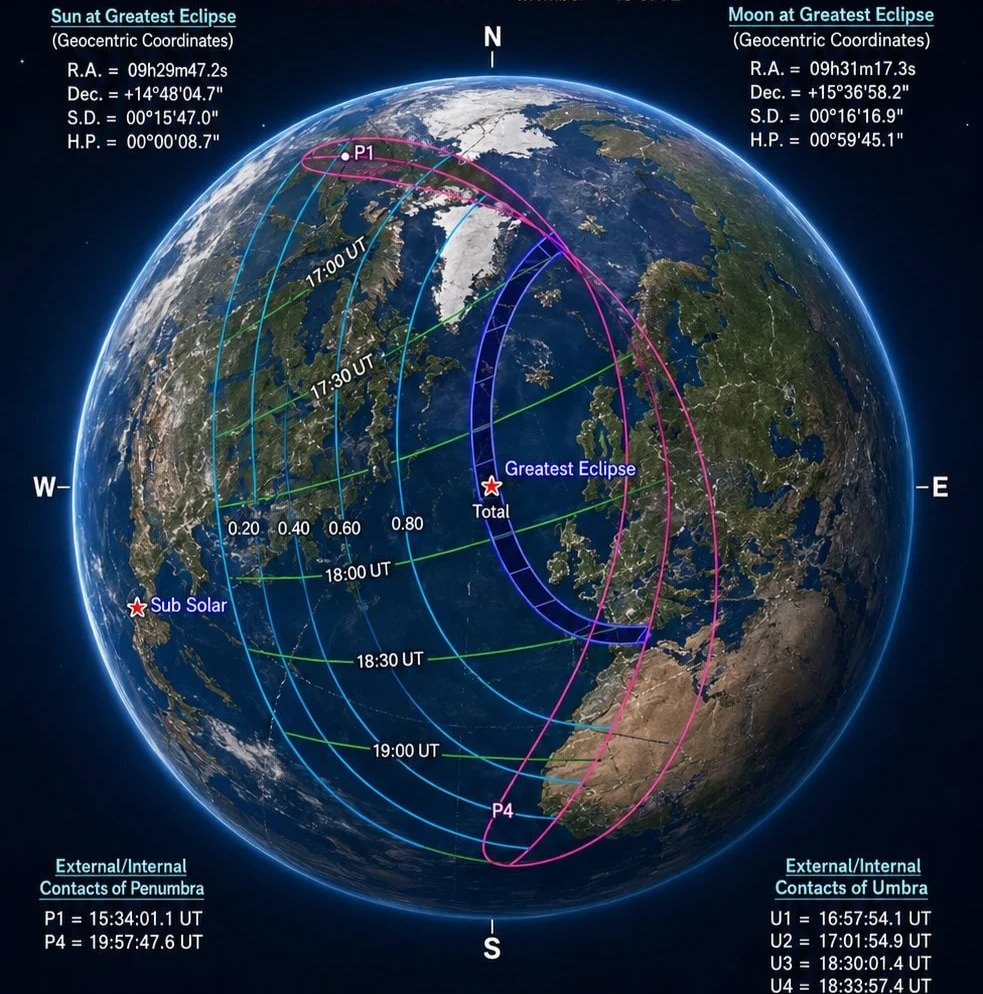
Total Solar Eclipse
In the afternoon there will be a TOTAL SOLAR ECLIPSE. This one is taking a northern curve near the arctic pole with the path of totality crossing northern Russia, Greenland, Iceland, the Atlantic Ocean, ending in Spain and a very small corner of Portugal. The instant of greatest eclipse—when the axis of the moon’s shadow cone passes closest to Earth’s center—takes place at 12:46 EST. It’s a relatively short total eclipse with a maximum duration of totality lasting about 2 minutes.
NEW MOON (hiding behind the Sun) occurs at 1:37pm making this a great night for …
the evening PERSEID METEOR SHOWER peak with up to 100 meteors per hour. You can start observing around 11 p.m. local time when the rate of shooting stars increases, but it will get even better before dawn. Look to the north, find Cassiopea, the constellation that looks like a W, and trace eastward, this will be Perseus, a stick figure with no head or hands. Then sit back and watch the light blossom.
August 15
Morning Sky Jupiter and Mercury conjunct
You can find Jupiter and Mercury, five degrees apart, in the constellation of Cancer on the eastern horizon in the dawn sky about an hour before the Sun rises. You will have to be somewhere very flat with no light to see this.
Evening Sky Venus at greatest eastern elongation
Venus reaches its maximum angular separation from the Sun (45°53'), making this the best time to observe the planet. Look towards the western evening sky. Venus will shine at a magnitude of -4.3 in the constellation Virgo.
August 16 Moon and Venus conjunct
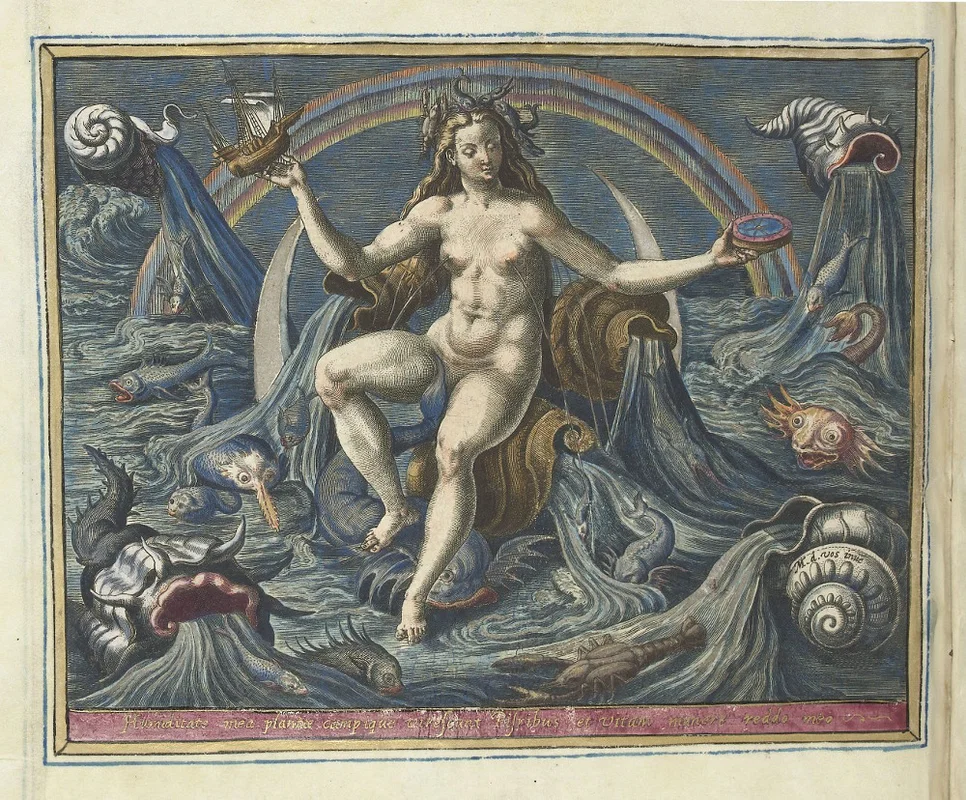
Moon and Venus
...with the Moon passing 2°04' to the south of Venus. The Moon will be 4 days old, positioned like a cup to hold the bright planet. While the Moon conjoins every planet during her monthly round across the sky, Venus’ own phases are aligned with the lunar phases so that Venus and the crescent Moon have come together each month in the sky for eons. Find them after sunset in the constellation of Virgo about 21° above the western horizon. They will then sink together towards the horizon about 2 hours later.
August 20 FIRST QUARTER MOON
August 27/28 FULL MOON (12:19am on August 28)
A DEEP PARTIAL LUNAR ECLIPSE: 96% of the Moon will enter the Earth’s shadow, with the maximum eclipse occurring at 10:12pm EDT. Much of the world will see this one. The eclipse will be fully observable from North and South America, visible at moonrise in the Central Pacific, and at moonset across Africa, Europe, and the Middle East. Travelling through the constellation Capricornus, the Moon will likely take on a dark orange hue rather than the classic blood-red of a total eclipse
August 31 Moon and Saturn conjunct in the constellation Pisces
The two will rise together in the east around 21:30 EDT, reaching their highest point in the sky at 03:41, 62° above your southern horizon. Then, they will be lost to dawn twilight at around 06:32, 41° above your south-western horizon.